
Leading Myself - Personal Power
Semester 3 - Day 2
Team Dynamics
Conflicts
This AMU course is offered in collaboration with Edutasia and has been developed and designed by
Asnæs & Vangstrup.

Preparation for Semester 3 - Day 2
Please review the Semester 3, day 2 webpage carefully.
This page also includes buddy group exercises to be used during your in-person meetings. These exercises are therefore not part of your individual preparation for the semester.

What, why, how?
What is it?
As employees in an organization, we are all confronted with the ups and downs of being part of a team. Disagreements in a team are natural, as we have experienced throughout this course; we are all different people who communicate and act in our own ways. Not because we want to cause conflict, but because we believe that our way of communicating is correct. Therefore, conflicts emerge due to disagreements and misunderstandings, and managing these is crucial to maintaining a productive team.
Therefore, this Semester 3 - Day 2 will include:
Understanding what a conflict is
Understanding how we contribute to conflicts without being aware of it
Identifying conflict management tools
Why is it relevant?
Conflicts emerge due to disagreements and misunderstandings, and managing these is crucial for staying a productive team. By handling disagreements constructively, they can become a key driver of innovation and development, helping the team remain relevant to the organization.
How do I practise it?
In order to manage conflict, we need to understand how we contribute to and react to it. Using the 180-degree survey, we identify whether there are gaps that contribute to misunderstandings. In addition, we will challenge ourselves when experiencing internal conflict and practice giving feedback to prevent the conflict from escalating.
Conflicts & conflict management
3 different types of conflicts
Organizational conflicts
– stem from the way the organization is structured
Lack of common goals and direction
Lack of/bad management
Lack of feedback on the effort and result
Rules that prevent one from doing their job
Low social capital (trust, cooperation, justice)
Too much work that needs to be done within a very short timeframe
The physical framework does not fit the work
Culture that focuses on mistakes and the things that lack
The conflict culture is not constructive
Unclear distribution of roles and responsibilities
Interpersonal conflict
- a relational conflict between people
Factors that can trigger interpersonal conflicts:
Bad communication
Missing information
Not having the understanding what lies behind a decision
Talking to much private
Says what the manager wants to hear
Perception that some are doing nothing
Symptoms:
Little will to participate in dialogues, but a bigger will to start discussions
Gets personal instead of discussing the issue
Having own goals instead of sharing the group’s goal
Forming clusters
It is about winning personally – not the collective reward
Emotional involvement
Them vs. us language
Having trouble with teamwork
Bullying
Intra-personal conflict
– a conflict within ourselves
Conflicts within ourselves:
do not believe our abilities are being used
considering changing jobs
do not feel good enough at what we do
believe that our work and private lives are not linked
going through a personal crisis such as stress, break up…
Symptoms of a intra-personal conflict
The employee:
Is Pulling away from others
Has limited energy and capacity
Shows resistance (to forexample tasks)
Is calling in sick (Sick leave)
Is pulling outwards – blaming others
Expresses a feeling of injustice
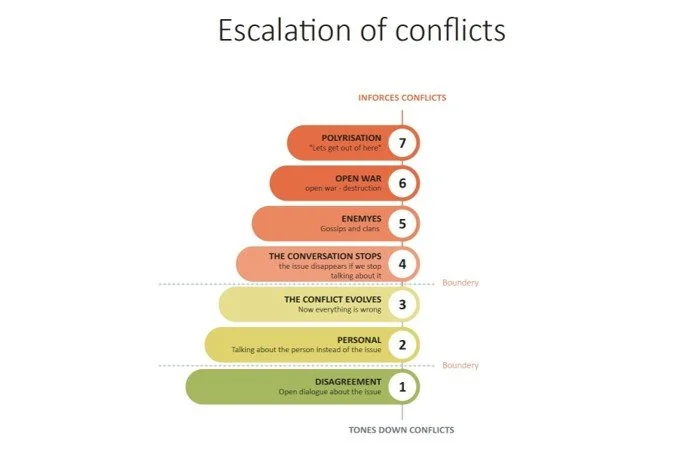
Escalation of conflicts
The person is never the problem. If you allow yourself to be the problem, you are already in conflict and are therefore not contributing constructively to a solution.
Always make sure to stay in your own half of the field
Be understanding of differences, feelings and needs
Listen and respond with empathy when others express their feelings
Be curious and ask open-ended questions
Remember to separate feelings from facts
Conflict Management is communication
Rememer this from semester 2?
Assertive communication
Based on non-violent communication. You start from yourself and are clear about your needs. The purpose is not to speak formal giraffe language, but to achieve closeness in the encounter with others who themselves meet you with an assertive approach. This makes it necessary to have a language that expresses peace and harmony and enables us to resolve conflicts peacefully. When you speak giraffe language, you create contact instead of conflict. In Giraffe Language, you use your feelings and needs as a starting point for a form of communication where you also understand how to listen to the feelings and needs of others.
Agressive communication
Agressive communication judges and accuse the other person, you hear what you want to hear and have difficulty sticking to the point. Agressive communication interrupts, asks leading questions. Often, guilt and shame are placed on the recipient, while one’s own principles are maintained. Instead of spending time and energy attacking each other, blaming each other, getting angry/disappointed with the actions of others, one can instead remind oneself of the value of assertive communication.
Conflict Management is difficult
Watch these videos to learn how to handle conflicts constructively through your communication.
Till next time:
Meet with buddy group to discuss:
??