
Leading Myself - Personal Power
Semester 2 - Day 1
Self-knowledge
Emotional Intelligence (EQ)
This AMU course is offered in collaboration with Edutasia and has been developed and designed by
Asnæs & Vangstrup

Preparation for Semester 2 - Day 1
Study Semester 2 - Day 1 webpage.
The webpage also includes buddy group excersises for when you meet. These excercises are therefor not part of your preparation for the semester.
Make sure your have finished your actionplan.

What, why, how?
What is it?
To continue leading ourselves in a purposeful and authentic direction, we need to consistently work on understanding ourselves, the patterns we are inclined toward, and the way we show up in the world. Self-knowledge includes both your behavioral traits and an awareness of your thoughts and feelings—and how they can sometimes hinder your self-development.
Therefore, Semester 2 - Day 1 will include:
Understanding the theory behind emotional intelligence and how it supports us in all our relationships, including the one we have with ourselves
Understanding how thoughts, feelings, and behavior are interconnected
Why is it relevant?
Understanding how to navigate between your thoughts, feelings, and behavior is key to knowing yourself. It provides the best foundation for contributing positively to relationships and for personal development.
How do I practise it?
We use our 180-degree survey to understand whether there are areas where our self-perception is challenged. We then challenge ourselves by practicing taking a meta-perspective to understand when and how we think, feel, and behave in certain situations.
Emotional Intelligence (EQ)
In short, Emotional intelligence is about our ability to understand and manage both our own and other people's emotions.
Daniel Goleman is the founder of Emotionel Intelligence.
Daniel Goleman: Emotional Intelligence
Daniel Goleman, the inventor of the concept of emotional intelligence, explains what you can do to work with this intelligence and how it can be used in the workplace.
Employees in a company observe your reactions daily, and these emotions become part of their consciousness.
Watch the video to learn more.
Daniel Goleman identifies 5 different competences:
Self-awareness:The ability to understand your own feelings and moods. This also includes knowing your values, goals, and competencies, as well as knowing who you are.
Self-regulation: The ability to manage your emotions so that you can use them to your advantage rather than letting them become an adversary.
Motivation:The ability to set ambitious goals and focus on achieving them, even when adversity arises.
Empathy: The ability to understand the feelings and needs of others, often described as “putting yourself in someone else’s shoes.”
Social skills:A set of skills that help you relate to others effectively. This includes skills such as leadership, persuasion, and social intuition.
Watch the video to understand what is the Amygdala hijack and why we experience it
Watch the video to understanding how EI adds value to work environment
Buddy group exercise:
Analyse the feedback from your 180-degree survey in the perspective of emotional intelligence.
Identify if there are gaps where your feelings might me hijacked and therefore interfere with your response/reaction towards colleague.
Identify if there is feedback that leaves you frustrated/irritated and reflect on how you can “navigate and controle” these feeling.
Become aware of when you tend to become hijacked and prepare how you wish to react.
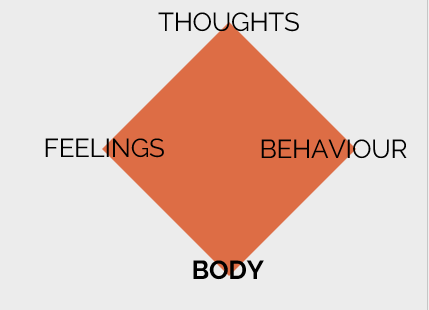
The Cognitive Diamant
The cognitive diamant adds body / fysical sensations to the traingle.
All feelings are stored in our body and therefore our body reacts to a certain situtations in certain ways, that can be difficult to understand at first.
By becoming aware of how you fysically react to for example conflicts, eye contact or loud noices, you can start navigating more appropiate to situations.
The Cognitive Triangle
The Cognitive Triangle (also known as the Cognitive-Behavioral Triangle) is a foundational concept in Cognitive Behavioral Therapy (CBT). It illustrates the interconnected relationship between our thoughts, feelings, and behaviors.
The core idea is that these three components do not exist in isolation; instead, they constantly influence one another in a continuous loop.
Buddy group exercise:
Identity feelings & finish the sentence:
When I need my managers help at work, I feel………
When I feel insure about my job, I usually…….
When I feel stressed in my job, I tend to.......
When I am irritated with a collegue, I usually…
Till next time: 14th October 9 - 11 online
Meet with buddy group to discuss:
Share with buddy group the last time you remember getting Amygdala hijacked and how you would approach the same situation today.
Send a resume of your discussion to marielouise@asnaes-vangstrup.dk
Deadline 7th october.