
Upselling in Operations
Module 1: Awareness
This AMU course is offered in collaboration with Edutasia and has been developed and designed by Asnæs & Vangstrup.
AMU 40003 purpose:
The participant can handle customer contact in connection with the sale of the company's products and services.
The participant can handle the initial contact with the customer in a positive manner, listen to the customer's needs and expectations, and complete the sale, including using techniques to close the sale.
The participant can also end the contact in a positive manner.

Online teaching
You will be introduced to:
Text to read and videos to watch
Questionaires to answer
In order to get a better understanding of your specific restaurants please enter the link to give a view on:
Current status on sales in your restaurant
What, why, how?
What are the sales definitions, used in this course?
Upselling
Upselling is a sales technique where you invite a customer to purchase a superior, premium, or more expensive version of the item they are already buying. The goal is to increase the total value of the single product being purchased.
The Concept: Buying the same thing, but a better/bigger version.
Cross-Selling
Cross-selling is a sales technique where you invite a customer to purchase additional, complementary, or related products alongside their original purchase. The goal is to introduce the customer to other product categories that enhance their primary purchase.
The Concept: Buying extra things that go well with the main purchase.
Bundling (Product Bundling)
Bundling is a strategy where several individual products or services are packaged together and sold as a single combined unit, usually at a discount compared to buying each item separately.
The Concept: Creating a convenient, package deal.
Why is it relevant to know the differences?
Being aware of the different possibilities in sales expands our options.
Excercise 2:
Conduct a small research within your team
The purpose is to understand which selling concept would be relevant for you and your team to practise more.
Research: For your next briefing or employee meeting, ask the following questions:
In your opinion, is up-selling in general our main focus?
In your opinion, could cross-selling be more relevant and what would our focus be?
Are you aware of which products to bundle and why?
Send a brief sum up of your research to marielouise before modul 2
Enter the link to answer questions on:
Sales definitions
The greatest barriere to sales:
Social capital
Trust - Cooperation - Fairness
Social capital is about creating value through employees by fostering value-creating relationships, respectful and effective communication and a constructive feedback culture that ensures everyone takes responsibility for their own communication and relationships.
High social capital directly impacts the organization’s ability to achieve positive results on the bottom line.
Social capital is about developing the qualities that enable employees to collaboratively work on core tasks (e.g., serving guests) and collectively achieve great results.
High social capital means that we excel at helping each other improve across functions while respecting each other's differences. This allows us to collaborate in the best possible way when engaging with guests.
It’s about “making each other shine.”
About Trust
To build trust as a leader, focus on:
Creating transparency
Delegating responsibility
Being actively listening
Communicating equally
Working on emotional intelligence
To foster a sense of belonging, trust is key. It drives engagement and contributes to a more committed and motivated workforce - and willingness to sell.
About Fairness
The feeling of fairness is very individual. As a leader, you can contribute to the sense of fairness experienced within the organization and by each employee by:
Ensuring everyone feels heard and involved
Treating everyone with respect
Handling conflicts constructively
Maintaining transparent processes and decision-making - and by that enhancing the willingness to sell
About Collaboration
Collaboration within a team and/or with other departments is essential for selling initiatives to be as convinient as possible.
Good collaboration requires:
An appreciative approach
A shared reality
Effective communication across all levels
Working with feedback
Awareness of each other's differences
Read text on social capital

Enter the link to answer the questions on:
Social capital & sales
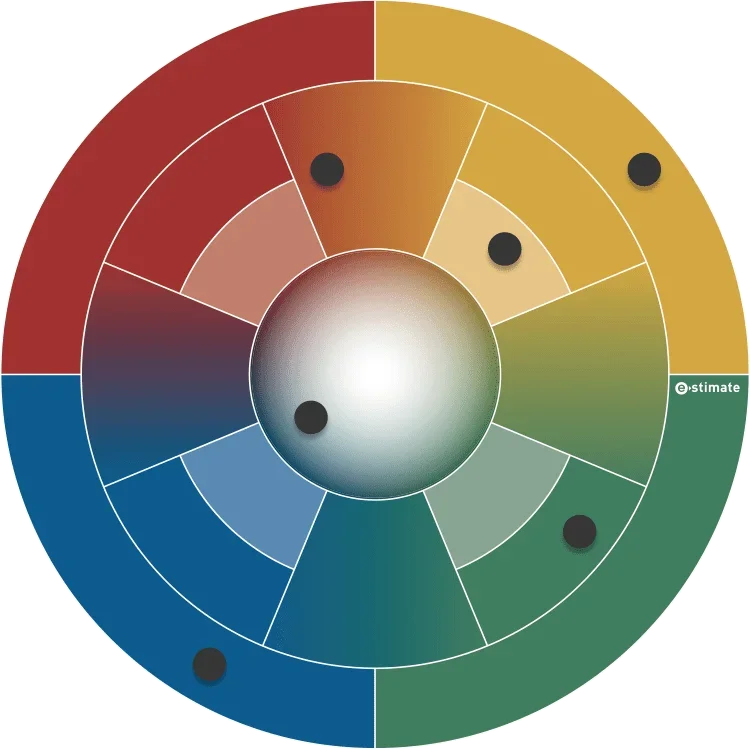
The 4 Archetypes Defined:
Dominance - The RED Profile: Focuses on results and achievements, recognized for taking action and taking the lead.
Influence - The YELLOW Profile: Emphasizes creativity and innovation, known for being enthusiastic and inspiring.
Concientiousness - The BLUE Profile: Values organization and accuracy, characterized by being methodical and detail-oriented.
Steadniness - The GREEN Profile: Prioritizes harmony and support, recognized for being patient and team-oriented.
The 4 Archetypes in DISC
In this context, we refer to four different archetypes. We all exhibit traits of each, but we often have a primary profile that we recognize, especially in challenging situations.
When interacting with others, situations often reveal that we experience things differently. We react in various ways and therefore often end up in different places.
By becoming aware of our own and others' behavior, we can use effective communication tools to clearly express what we want, ask questions more easily, set boundaries, and handle criticism constructively.
The better you are at being aware of your own and others' behavior, and mastering assertive communication, the more impact you will have among your peers, colleagues, and employees.
This means you’ll find it easier to be heard and understood, and others will trust you more. It also reduces disagreements because you tend to ask curious questions rather than judge others.
THE YELLOW PROFILE
Is adventurous and courageous
Outgoing and full of energy
Ideas can flow so freely that it can be overwhelming
Not afraid to take risks or seize opportunities
A colorful person with expressive, descriptive language
Enjoys the freedom to create
The major weakness is unpredictability. Because he/she often thinks quickly and changes his/her mind just as fast. He/she can be too far ahead of everyone else.
THE GREEN PROFILE:
Caring and helpful
Friendly and well-liked by others
A good listener
Sensitive to others' feelings
Not afraid to help others
Collaborative
Loyal
The major weakness is that the person is easily led astray because of a trusting nature and not thinking ill of others. They may also be low-energy and hide it behind a facade of false friendliness.
THE BLUE PROFILE:
Detail-oriented
Logical and reasonable
Persistent and often strong-willed
Plans and executes
Values routines, rituals, and procedures
Fearful of making mistakes
Very interested in facts
The major weakness can be a lack of courage—fear of making mistakes. They want to have control over everything and may believe in their own infallibility.
THE RED PROFILE:
Ambitious and Performance-Oriented
Goal-focused
Leads the way
Prefers to lead alone
Seeks full control
Excludes those who don’t fit
Quick to reward and punish
The major weakness may be that they want to do everything by themselves and therefore has difficulty trusting others. They may also struggle to accept others' methods.
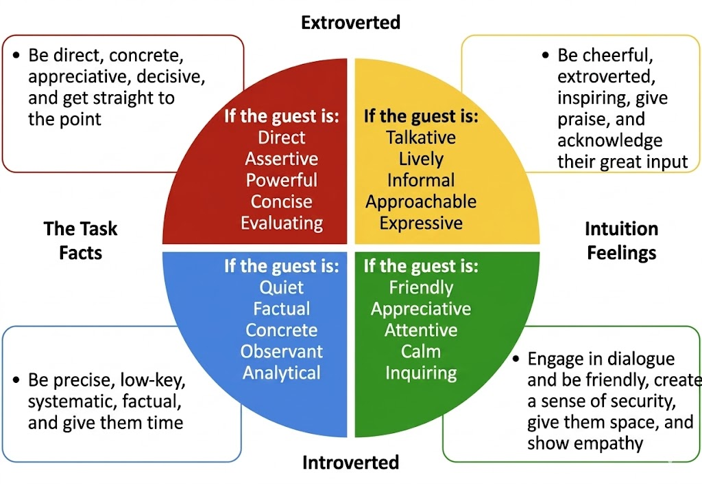
The DISC archetypes can also help us understand guests and how to approch them best.
Example:
When you think about your team and which profiles they represent.
Imagine that you have a S - GREEN waiter who serves a D - DOMINANT guest.
What could happen in the communication?
How could you train the waiter in matching the guest profil, eventhough it is not his/her natural behaviour?
Enter the link and answer the questions on: DISC profiles & sales

Thank you & see you
next time at
Restaurant Ambra
30th June 8:30 - 12:15