
Upselling in Operations
Module 3: Feel the impact
This AMU course is offered in collaboration with Edutasia and has been developed and designed by Asnæs & Vangstrup.
AMU 40003 purpose:
The participant can handle customer contact in connection with the sale of the company's products and services.
The participant can handle the initial contact with the customer in a positive manner, listen to the customer's needs and expectations, and complete the sale, including using techniques to close the sale.
The participant can also end the contact in a positive manner.

Online teaching
You will be introduced to:
Text to read and videos to watch
Questionaires to create reflection
TO ASK OR NOT TO ASK…
Is it selling or providing hospitality to ask
guests if they want a pre-dinner drink?
It’s a simple question…
(and most people answer that it’s selling, although it could be argued that without that question, hospitality is lacking…)
Now add a small barrier to the question:
Barriere 1:
Is it selling or providing hospitality to ask a table of guests - who are in the middle of a discussion - if they want pre-dinner drinks?
Barriere 2:
Is it selling or providing hospitality to ask a table of guests – who look like they can’t afford it - if they want pre-dinner drinks?
Barriere 3:
Is it selling or providing hospitality to ask a table of guests - who are irritated because of a mistake in their reservation - if they want pre-dinner drinks?
What do you think the guests feel and think if they are not asked that 1 question?
Barrier 1:
The guests could feel:
unwelcome
like they are disturbing or “in the way”
Barrier 2:
The guests could feel:
unwelcome
“wrong" or misplaced
Barrier 3:
The guests could feel:
unwelcome
like they are being “punished” for being irritated
Therefore; to ask or not to ask.
In general, “to ask” is always the right answer.
Enter the link and answer the questions on:
To ask or not to ask
Exercise 2:
Homestudy: Conduct a short research
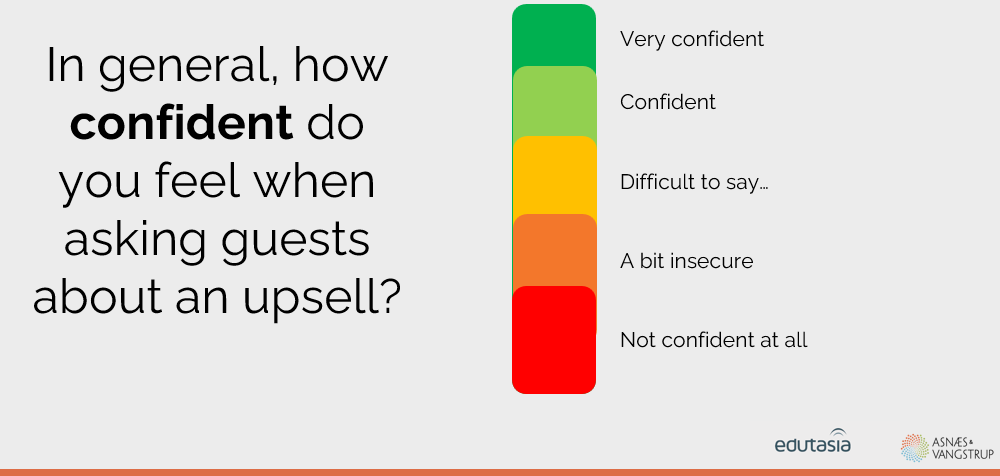
Draw or print this scale below.
Present it to the team and ask them to mark on the scale their feeling.
Take a picture of the scale with all responses and send it to marielouise before
17th August
How can we ask questions that both provide
hospitality and sell at the same time?
OPEN QUESTIONS
Questions that start with:
How….
What….
When…
(in stead of:
Do you want to buy…?)
Example A:
Waiter 1:
“Welcome. How would you like to start your evening?”
Waiter 2:
“Welcome. Do you wish to want to buy a pre-dinner drink?
The 2 examples illustrate the difference between hospitality & selling a product.
Which waiter would you prefere?
STORYTELLING
Stories creates feelings and feelings are key to selling.
When we add a story to our product, we help the guest to feel how it would be, to buy the product.
Example B:
Waiter 1:
“I can recommend the wine from Toscany. I personally went to visit the wineyard and had a great chat with the founder. He was so passionated!…”
Waiter 2:
“Which wine would you like?”
The 2 examples illustrates how storytelling can help create feelings and expectation to a product. Which makes it more interesting for the guest. Some might say that waiter 1 provides hospitality and waiter 2 does not…
Remember, storytelling is not only related to a product. It can be about a venue, the menu, the waiter etc.
Which waiter would you prefere?
MATCH THE GUEST
All guest are different in their behaviour and approach. If you train your ability to match your communication to the guests’ communication, the guest will most likely feel the attention.
Example C:
An elderly couple visit a restaurant for the first time. They are hesitant to order.
Waiter 1:
“Welcome. What brings you here tonight? If you want, I will be happy to go through the different options with you”
Waiter 2:
“Welcome, what can I get you?”
The 2 examples illustrate how one waiter uses a slow and detailed approach to the guest. The other doesnt take notice of the guests insecurity and uses a more direct approach.
Some might say that waiter 1 provides hospitality and waiter 2 does not…
Which waiter would you prefere?
Enter the link to answer questions on:
Selling or providing hospitality
What is the difference between service & hospitality and why is it relevant?
Watch the video and enter the link below to answer questions →
Price & offers
Carefully being aware of the price and offers you have, can actually helo you nudge guests into buying more of the expensive options. The concept applies to prices that are relatively close to one another, meaning you cannot compare just any product.
A study has showed that if you offer two variants such as redwines at two different price points,
the result is as follows:
Redwine at 100 DKK was chosen 80% of the time
Redwine at 150 DKK was chosen 20% of the time
However:
If you instead offer three redwines.
One at 100 DKK, one at 150 DKK, and one at 200 DKK the following showed:
Redwine at 100 DKK was chosen 40% of the time
Redwine at 150 DKK was chosen 50% of the time
Redwine at 200 DKK was chosen 10% of the time
Exercise 5:
Test the “price & offer” experiment for 1 week.
Make sure to register your observation and results.
You don’t have to use the same prices - it’s the concept of 3 vs. 2 prices that you test.
AFTER having tested the experiement for 1 week enter the below link and answer the questions:
Thank you & see you
next time at
Restaurant Ambra
17th august 8:30 - 12:15